Monday, 9 August 2010

The last frontier

 
OK, Mongolia might not really be the last frontier on this planet, but it's certainly up there alongside Papua New Guinea, Greenland, and Bavaria (Austria). The vastness of the landscapes, the harshness of the climate, the very traditional way of life of the rural population, the “food”, and the interesting transport system even surprised relatively experienced travellers like Judith & me. Thankfully, mostly in a positive way.This is our longest post yet - sorry - but at least we've again included many pics, and two shockingly revealing videos. 


We got to Ulaanbaatar, capital of the most sparsely populated country in the world, by train from Beijing, capital of the most populous country in the world. The Transmongolian Railway is part of the famous Transsiberian Railway route, and it's definitely worth the 32-hour ride. Leaving from Beijing, you get a very good impression of the Northern Chinese countryside, the Gobi Desert, and Chinese and Mongolian immigration procedures (based on what happened to the guy in the compartment next to us, I'd recommend not to get into an argument with the Chinese border police). 


Judith & I spent the first few days in UB (as the cool guys like to call it) sorting out our next tours, and buying the last items for our camping plans. UB holds the title for being the world's coldest capital (temperatures allegedly can drop below -45° C in winter), but while we were there, the Continental summer climate treated us to some nice +30° C. The city is a strange mix of Soviet architecture, traditional Mongolian Ger tents, and increasingly Western influences.


Having concluded our preparation efforts in UB, we headed to the Bulgan & Arkhangai Provinces some 400 km West of the capital. As part of a semi-organised tour, we had arranged to stay with different nomad families, which allowed us to gain some brilliant insights into their lives. Except for the odd motorcycle and maybe a fancy black & white TV linked to a solar panel with an old car battery, the daily life of the nomads is still pretty similar to what it was centuries ago. A typical nomad family would consist of three generations sharing one or two Ger tents. As a result, privacy is very limited, which made us wonder how they manage to, well, perform the necessary tasks to ensure that there are enough descendants to take over the family business.


Being herders, the nomad families typically own several hundred sheep, goats, horses, cows, yaks (Rastafari-cows), and maybe some oxen and camels. In order to protect the Gers and the livestock (against e.g. wolves), most families have pretty aggressive dogs. Before getting off your horse or motorcycle when arriving at a Ger, it is therefore highly recommended to save the small talk for later and shout “Hold your dog” instead. Since Mongolians are nice people, they will actually do it and hit the dog for you - yes, it's all a bit rougher out there. But seriously, the people we met were very nice, down-to-earth, and welcoming. 


Most of the nomad men we encountered didn't show a lot of facial expressions at first, but after some days (or glasses of vodka), they opened up, too. As far as the kids are concerned: it must be pretty tough for the children to grow up in the middle of nowhere without any neighbouring kids to play with. To make things worse, sometimes complete strangers show up and take away their favourite toys - click on the shocking video below. 


Talking to the families turned out to be quite challenging, but we managed somehow. Thankfully, the Soviets had introduced Cyrillic in Mongolia, which made reading easy-peasy compared to Japan and China. What is more difficult is the pronunciation of Mongolian. An unnamed neutral observer has likened it to “the sound of two cats fighting until one of them throws up”. We have to concur. Compared to Mongolian, even Czech, (Swiss) German, and Dutch sound like lovely melodies sung by long-haired virgins.


In summer, the nomad families eat & drink tons of dairy products... milk, fermented milk, cheese, dried cheese, curds, dried curds, yoghurt, salty milk tea. If you're lucky, you'll get a bit of mutton. Proteins and fat for a lifetime. We will provide more details about our culinary experiences in our next separate blog post on food. 


Besides eating, Judith & I spent a lot of time riding horses & camels. In that context, we found out that wooden saddles (why would anyone ever even consider making a saddle out of wood?) are not exactly ideal for ridiculously bad riders like us. Luckily, we had gringo-friendly leather saddles that one day when we had to gallop down a mountain in the middle of a surprise hailstorm.


Another interesting aspect of Mongolian culture we got a chance to witness was Naadam, the annual sports festival held in summer in every town throughout Mongolia. It consists of three official disciplines. Wrestling (ideal for fat men), archery (for those men not big enough for wrestling), and horse racing (for little boys). For us, seeing those little boys of maybe 5-8 years race their horses like madmen for two hours was very impressive. Some of them didn't even use a saddle. Kids of that age in the Western world still build castles in their sandboxes.


After some two weeks, we headed North to Khövsgöl Province, which is famous mostly for the huge 136km long, 267m deep lake bearing the same name. Lake Khövsgöl probably is the most beautiful lake I have ever seen, featuring crystal clear water and pristine coastlines. 


Judith & I rented a kayak for 5 days, packed our tent, some food, my vodka pocket flask, and a fishing rod and off we went. Judith actually managed to catch dinner for us, while I, feeling slightly emasculated, at least got to kill and barbecue the fish. 


The Eastern shore we visited is not very to not at all accessible by car, which is why we felt truly detached from the rest of the world. Beautiful. The only people there were the Mongolian president and the leadership of his Democratic Party, who did a joint camping trip together. Now that's something you wouldn't see in many other countries. Can you picture Sarko and Carla Bruni going camping with the UMP elite?


Speaking of accessibility: transport in Mongolia is definitely worth a separate mention. The roads and the means of transport in Mongolia are by far the worst Judith & I have ever encountered.  Outside UB, roads are virtually non-existent. The people in their 4x4s just speed across the grasslands and rivers. Unfortunately, being on a tight budget, we did not want to pay for a more comfortable Japanese 4x4, and opted for a Soviet/Russian Jeep (based on a design from the 1930s!) instead. They are truly horrible. The hopelessly overloaded Russian minibuses are even worse. By comparison, Latin American chicken buses seem like first class flights with Virgin Atlantic. As promised, here's our second video of the day...


The lack of roads certainly adds to the Mongolian last frontier-charm. Maybe this is why we met many people from all over the world who had been on the road for a long time. Compared to their massive undertakings, the extent of our small trip is put into perspective:  

Check out this French-American who has been on his motorcycle with a sidecar for more than six years: http://www.thetimelessride.com/

Or this German guy who travels the world by 4x4 & paraglider: http://www.human-multivisions.com/

Or this nice Swiss couple who managed to drive to Mongolia in a cute minivan:
http://www.oschtwerts.blogspot.com/


So, to summarise: Mongolia has been a definite highlight of our trip. If you're the outdoorsy type, you have not seen this planet if you haven't been to Mongolia. Our last two stops since – Beijing & Hong Kong – have been very different. But great nevertheless. We will upload the respective post over the coming days...So once again, thanks for taking your time to read through this, and I promise the next posts will be shorter again.

Tuesday, 27 July 2010

The stats - a snapshot


We are well into our 5th month of travelling now and have bombarded you poor souls with many blog posts. Remember our original travel plan (The plan)? Maybe some of you have lost the overview of exactly what we are doing here, and to be honest, even Judith & I sometimes only have a vague memory of some of the details - looking back, bus terminals in Panama and Costa Rica do seem dangerously similar.

To make up for this, we have spent weeks in the Mongolian steppe working out the summary statistics of our travels so far - with some surprising results (can you feel the tension rising?). This is bottom-up data, so it's pretty accurate. Yepp, we admit to keeping a nerdy Excel-spreadsheet where we track everything.

Over the past 5 months:
  • we travelled through 9 countries
  • we covered more than 55,000 kms using different means of transport (now this huge number, for example, even surprised us. See below for details)
  • we set foot on 3 continents (let's take the US definition of "two Americas", it sounds more impressive)
  • we slept in 49 different locations, including 5-star hotels, friends' homes, boats, buses, trains, gers, hammocks, and a mini tent
  • we departed from, transited, or arrived at 16 different airports
  • we met up with 20 (!!) amazing people we know in 6 of the 9 countries - a million thanks again to everybody we met. Not to mention all the other characters we got a chance to meet for the first time
  • we managed to grow our hair by some impressive 10 cms - Argentinian footballer look, here I come!
  • we maintained a solid health almost all the time despite eating and drinking very strange stuff in dubious hygenical environments. Only yesterday, we drank fermented mare's milk, the king of drinks in Mongolia
  • Judith took pictures of more than 200 different flowers
  • I did >10,000 push ups and >15,000 sit ups (with all that money spent on travelling, there wasn't enough dough left for liposuction)
  • we were laughed at by -among others- Argentinians, Brazilians, and Japanese when trying to show off our dancing skills
  • we got scarily close to 6 snakes in different locations
  • we worked through 7 travel guide books and read 12 other books
  • we got up 9 times in the middle of the night trying to watch world cup games in Japan, China, and Mongolia
  • we rode on 5 different horses and 2 camels each
  • I got pick-pocketed once and Judith's one pair of pants got stolen once while drying outside (stealing the second pair off her legs would have been quite challenging I suppose)
  • Judith & I never really got into a serious fight despite spending almost 24/7 together
  • we woke up many times thinking that doing this trip was the greatest decision ever


    As promised, here's an overview of the means of transport used during our travels. Again, there is a huge variety in the quality and comfort we experienced: surprisingly, business class flights and oxcarts can be quite different. Probably the worst we have been through were very overcrowded Mongolian mini-buses (20 people in a car designed for 12 are pretty standard, not to mention the incredible number of sacks of rice, potatoes, and stacks of eggs). Please note that we have excluded walking/hiking and local transport like subways or taxis, since it'd just be too much.


    So much for the facts & figures. Currently, we are sitting in our Ger (Mongolian house tent) in Ulaanbaatar, having returned from our amazing 3.5 weeks on the Mongolian countryside. We will share these experiences in our next, picture-heavy post, probably posting from Hong Kong. Mongolia was beautiful, so please feel free to check our blog again over the coming weeks. Cheerio.

    Wednesday, 7 July 2010

    The food - Part 2


    Mmmh, food. In our last food post (The food - Part 1), we stereotyped our way through Latin American cuisines. Since Japanese food is totally different from what we are used to (and so much more than sushi), we thought this would be worth a separate post as well.

    Japanese culture (and with it Japanese cuisine) developed relatively independently for centuries, which is why people there eat things Judith & I didn't even know existed. But, except for some really strange stuff, we both rank it as one of the most tasty and certainly most healthy cuisines we know. I'm not aware of any country where food is considered that important (sorry, France), where the degree of freshness is that high, and where you find so few bad restaurants.

    Being an island, seafood (literally) tops the table in Japan. It comes raw (as in the 'world food' sushi or sashimi), grilled, or fried (as in tempura). So far, so good. However, the sheer variety of seafood available is mind-boggling and beats everything you'd get in the West. For example, we ate sea urchin sushi (in retrospect, I'd consider this to be an example of the strange stuff), different types of seaweed, octopus, mussels, and shellfish*. In the world of sushi, o-toro (fatty belly tuna) is the best in that it literally melts in your mouth – in Europe, you would get o-toro only in a few upper-class sushi places. Unfortunately, bluefin tuna (your friendly supplier of o-toro) tastes so good that mankind (including me) has managed to eat up almost all of its global population. Fortunately, there is some of its cousin yellowfin tuna left, so we all can enjoy more sushi before we manage to let the yellowfins go extinct, too.

    Seafood in Japan typically is accompanied by, of course, white rice and sour or savoury pickles on the side. Some of the pickles take some time to get used to, but generally, they go well with the rest of the dish. By German (not to mention American) standards, the servings are not particularly huge, but somehow the rice suffices to fill you up.

    If you're on the go, the very handy bento boxes can be bought everywhere. They usually have some seafood, rice, pickles and some other, unidentifiable things inside – ideal for travellers like the one depicted on below.


    There's more to Japanese food than rice and seafood, though. When going out to a pub-restaurant (izakaya) at night, food like yakitori (chicken (heart or liver or wing) skewers) is a perfect companion for the lovely Japanese beer like Sapporo & Suntory and sake.


    On the more expensive side, Japanese wagyu beef is very delicious as it has a very high fat and therefore taste content**. Ayako, a friend of Jan-Hendrik, even had to take us to the same teppanyaki place (where the food is prepared at your table) in Tokyo twice because the wagyu was that good. The most famous region for raising wagyu is around Kobe, but actually almost all Japanese wagyu is excellent, so you can save on the Kobe-premium and order more of the stuff instead. 

    Japanese are big fans of noodles. Udon, soba, and ramen (ramen actually are of Chinese origin) are a relatively quick, cheap, healthy, and tasty dish and saved Judith, me, and our wallets from starvation several times.  


    You might be shocked to hear that tea is an integral part of Japanese culture & cuisine. Everywhere you go, you get served hot or cold green tea, often for free. On more special occasions, you can order matcha, a relatively thick green tea with a thin foam layer on top, or more exotic teas like bean tea (thanks again, Toshiki).

    If you see what looks like ping-pong balls in Japanese sweets shops, don't be surprised. Mochi are rice-starch-based balls with a very strange texture, and come with different fillings like blueberry, chocolate, or matcha (see above). Lovely.

    The are many more types of Japanese dishes which we have tried, but again, it's just not possible to list them all in great detail. Here's an excerpt of our list for the letter 'O':
    • Okinawan food from the remote tropical islands belonging to Japan features fatty pork and bitter, strangely shaped cucumbers (see below).
    • Okonomiyaki, Japanese pancakes, come with cabbage, egg, various sauces, and other ingredients and are often prepared in a teppanyaki-style right in front of you. Comes with noodles (Hiroshima style) or without (Kansai style).
    • O-toro: eat until there's nothing left.


    Shopping in a supermarket in Japan is great fun. People looked as us with amusement as we got out our camera and took pictures of the colourful shelves with the unknown food. The variety is great, and it seemed like again the produce there was really fresh. 


    Oh, and in case you are wondering: Judith's favourite Japanese food is Mochi, and I still haven't made up my mind on whether to go for wagyu or grilled freshwater eel (unagi). As mentioned before, we are in Mongolia now, a country with a cuisine reputed to be as stellar as in Iceland. Quite a difference to Japan, but interesting nevertheless. We're leaving the civilised world tomorrow, so it might be several weeks until you hear from us again. Conversely, the progress of the internet seems unstoppable, so we might get back to you earlier than expected.  

    ___________________________________________________________________________
    * Don't you think it's selfish to eat defenceless shellfish? Think about it.
    ** Why is fat content and taste so highly correlated? Why can't veggies be unhealthy instead? It's a tough life.

    Sunday, 4 July 2010

    The land of the rising sun - Part 2 of 2


    Ooops, this blog post should have been up and running earlier – sorry. Anyhow, it's only partly our fault (the old trick, always blame external factors). We were in Beijing until yesterday, where the government has blocked access to blogspot (and facebook and youtube for that matter). At least, somebody has finally realised the immense threat that this blog poses to the political stability of a world superpower. Having arrived in Ulaanbaatar, we can finally upload. To make up for our little delay, we have included more pictures and less text than usual - yay!

    So where did we leave off? Right, Hiroshima. After Hiroshima, we headed for Kyoto, the former cultural and political capital of Japan. I guess there hasn't been a single tourist to Japan yet who didn't stop in that city of a rumoured 1,600 temples, 400 shrines, and many palaces - 17 of which are UNESCO World Heritage Sites.

    In case you are as ignorant a Westerner as Judith & I were and don't really know the difference between a shrine and a temple, here's a little guide. Of course, we're oversimplifying (again), and it might as well be the exact opposite way around.
    • Shrines = Shinto, orange & white, torii gates, burn down a lot.
    • Temples = Buddhist, wooden brown & white, Buddha statues (really?!), burn down a lot.
    • Palaces/ castles = for rich/ powerful people, often have those creaking nightingale floors so the rich/ powerful could hear their enemies sneak up on them, burn down a lot.


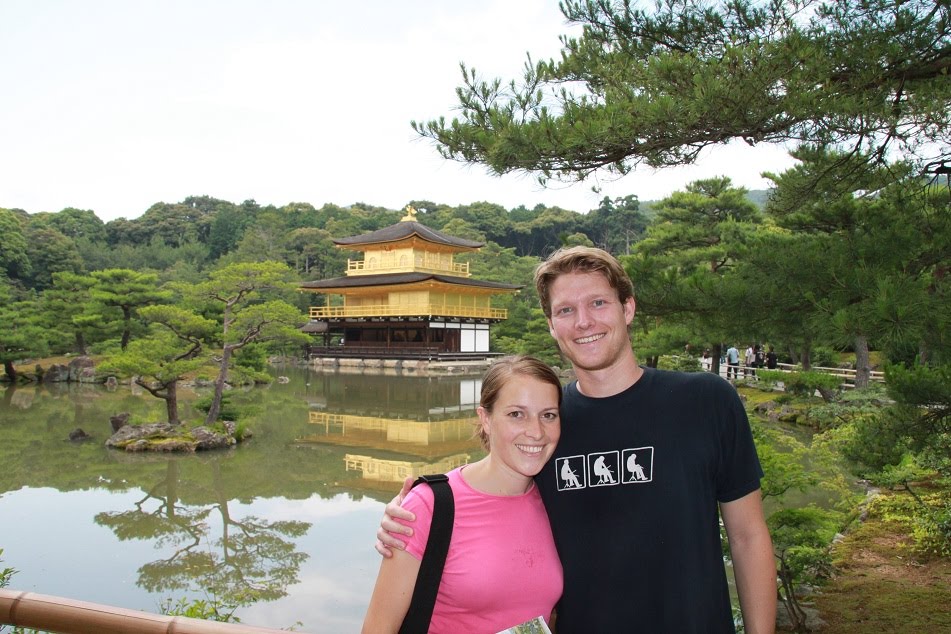
    It might not have escaped you that all of the above have a tendency to burn down quite easily. The preference for wooden structures combined with an obsession for the open flame (ceremonies, lighting, heating, burning arrows, arson) means that almost all temples, shrines, palaces, and castles have had to be rebuilt at some stage, often several times. That doesn't make them any less impressive, though. Our favourites included a temple with 1000 wooden statues painted in gold, a shrine with hundreds of torii (see below), and the golden palace built by a modest rich man (also see below).


    Several schools of Buddhism are headquartered in Kyoto, meaning that some of the temple compounds are massive. Many of them feature beautiful gardens and parks. The famous Zen gardens (a must-have for any Hollywood star) are truly stunning and convey an air of harmony and tranquillity which is hard to match.


    Of course, there are certain rules you should follow when visiting the sights. Before entering a shrine, for example, you typically wash your hands and mouth with water using the large wooden spoons provided.   


    It's not all about temples, shrines, palaces, and castles, though. The second, no less interesting side of Kyoto is the traditional part of Japanese culture often referred to as “Geisha culture”. Before the 2nd World War, there were thousands of Geishas and Maikos (apprentice Geishas) around, most of them in Kyoto. Ever since, that number has fallen rapidly, and today there are only a few hundred left. Geishas spend their most of their time playing (drinking) games, reciting poems, playing an instrument, telling jokes, singing, and generally entertaining 60-year old Japanese politicians and executives. Real Geishas are hard to find, but you sometimes see one rushing to a new appointment in some of the very expensive traditional tea-houses. Their rarity has made them a tourist attraction, both for foreigners and Japanese. Thanks to our zoom camera, we are able to provide you with this exclusive shot (of what we think is a Maiko), paparazzi style. 

     
    Having spent the past weeks in big cities, our small-town upbringing gained the upper hand again in that Judith & I really wanted to see something of the more remote Japanese countryside. Since we didn't have enough time to go to the Northern island of Hokkaido, we decided to spend some time around famous Mount Fuji instead. I'm sure you've all seen pictures of this iconic, almost perfectly shaped mountain volcano (well, you have now). The surrounding area of Kawaguchiko is beautiful, too, with lakes, forests, and a sleepy small-town feel. It's so small that we didn't even find a place to watch the Germany-Ghana match at 3.30am... Frustrated with the appalling quality of our emergency internet streaming, we decided to skip the second half of the match to watch the perfectly pink sunrise over Mount Fuji at 4.30am. Not bad, either.

    We enjoyed engaging in some of the more outdoorsy activities like cycling, hiking, mimicking statues, and a wee bit of climbing around Mount Fuji, but paid for it dearly with very sore muscles for days to come. Sissies. It will be interesting to see how we'll cope with hiking for days with our 20+kg backpacks in Mongolia.

    Our last stop in Japan was Tokyo. We were glad to come back there, since we both love the place. Among many other things, we visited Yoyogi Park on Sunday afternoon. Around that time, the park is usually packed with young bands performing and rockabillies dancing and dressing like in the good olden days. Fabulous.


    We also tried some delicious tea with Toshiki, whom I know from my studies in London, and met up again with Jan-Hendrik and his friend Ayako for football & food.

    I have mentioned the incredible size of Tokyo before. The best time and place to experience this is at night when the lights of the city come out, ideally from the top of a tall building. We went to the Tour Eiffel-copy Tokyo Tower and once again were amazed. Pictures can't really capture the atmosphere (also see the very first pic of this post not capturing the atmosphere), but anyway...
     
     
    This closes our Japan chapter – well, not really, we'll write a bit about Japanese food in a separate section. Where to next? After a stopover in Beijing, we are now in Mongolia. Quite a difference to everything we've seen before. Given the lack of electricity and internet connections in a lot of the places we are about to visit, it might be a while until we get back to you on this. But have faith in us: we will be back.